

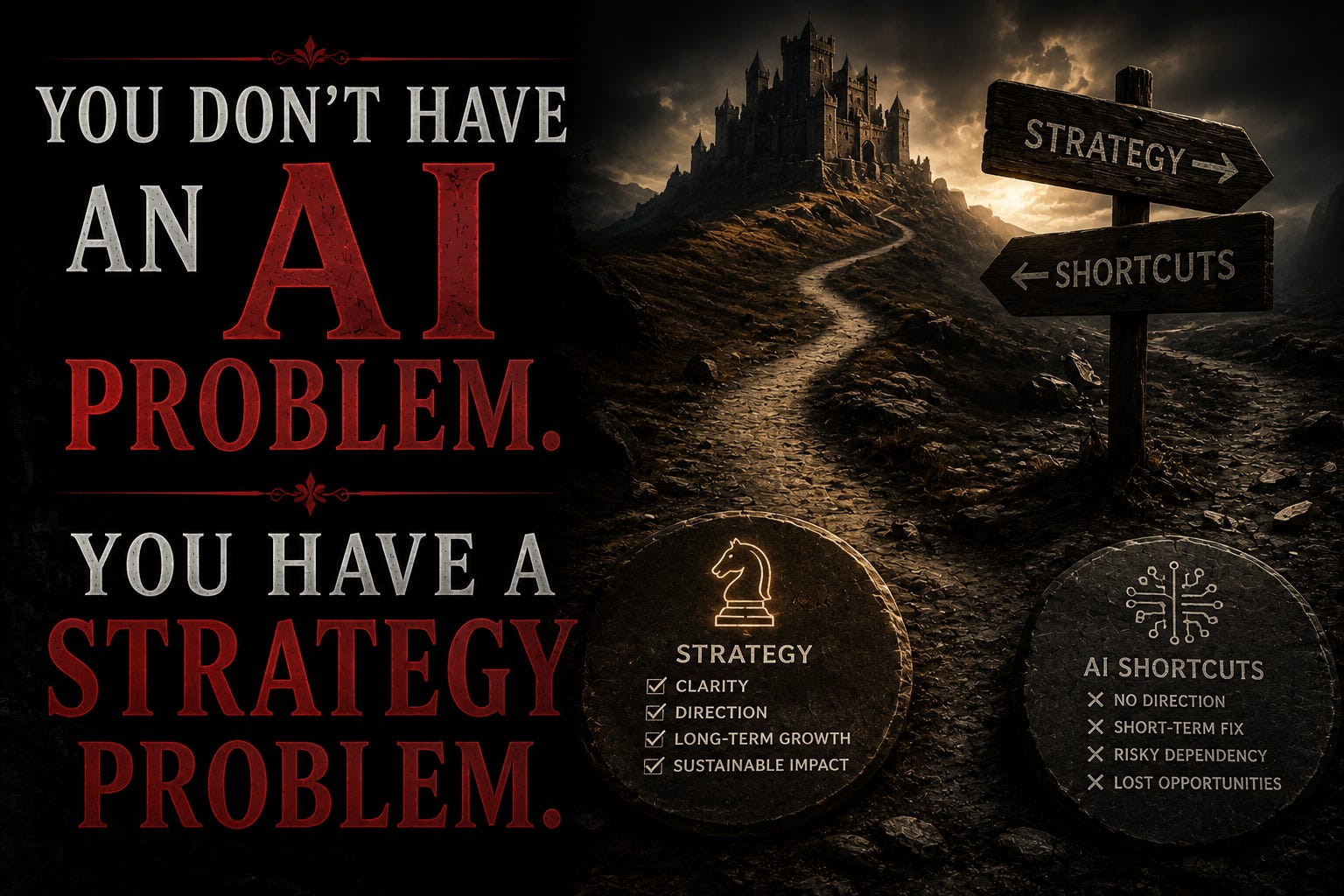
Most businesses didn’t adopt AI because they had a clear strategy. They adopted it because everyone else was, and sitting on the sidelines felt riskier than jumping in.
So they bought the tools. They set up the accounts. They told their teams to “start using AI” and waited for the productivity gains to show up.
And for many organizations, those gains have been... underwhelming.
Not because AI doesn’t work. It does. Remarkably well.
But adopting AI without a strategy is like buying a commercial kitchen and expecting gourmet meals to appear. The usefulness of the equipment depends on the operator’s skill and objective.
The companies struggling with AI right now don’t have an AI problem. They have a strategic problem. And until they recognize that distinction, no amount of new tools will fix it.
The Adoption Trap
Here’s what the adoption trap looks like in practice.
A company rolls out ChatGPT, Copilot, or whatever the tool of the moment is. Usage goes up. People start using it for emails, for summarizing documents, and for generating first drafts. Leadership sees activity and calls it progress.
But nothing fundamental has changed.
The workflows are the same. The decision-making process is the same. There has been no change to the organizational structure. AI has been applied broadly, leaving people confused next quarter, when competition remains unchanged.
The problem isn’t the tool. The problem is that nobody asked the harder question before they deployed it: What are we actually trying to change?
That question is where AI strategy begins. And most organizations skip it entirely.
What a Real AI Strategy Looks Like
A real AI strategy doesn’t start with tools. It starts with problems.
Specifically, it starts with three questions:
Where are our biggest bottlenecks? Focus on the hidden costs, not the obvious ones, which drain your resources and hinder growth. Where does work slow down? Which environments see decisions take longer than they should? Where are your best people spending time on things that shouldn’t require their expertise?
What decisions could be made faster with better information? AI’s most underused capability isn’t content generation. It’s pattern recognition at scale. Top AI-adopting organizations utilize it to expose insights teams lack the bandwidth to find, and to facilitate more intelligent, rapid choices.
Where could removing the friction compound over time? This is the big one. A ten percent improvement in one area is nice. A ten percent improvement across every handoff, every approval cycle, every communication loop — that’s transformational. AI strategy is about finding the places where small efficiency gains stack on top of each other until the cumulative effect is unrecognizable from where you started.
Once you’ve answered those questions, the tools become obvious. You’re not picking AI features, looking for a problem to solve. You’re solving actual problems and choosing the right tools to help you do it.
The Organizational Readiness Nobody Talks About
Here’s something the AI vendors won’t tell you: your organization might not be ready for AI — and that’s okay.
Not “not ready” in a technical sense. Most tools are accessible enough that technical readiness isn’t the issue. Not ready in a cultural sense.
AI adoption fails when organizations haven’t done the harder work of first clarifying their processes. If your workflows are inconsistent, if your data is messy, if your teams don’t have shared definitions of success — AI won’t fix any of that. It will amplify it.
Garbage in, garbage out isn’t just a data science principle. It’s an organizational truth. AI is extraordinarily good at doing things fast. If what it’s doing fast is wrong, confused, or misaligned, it just gets you to the wrong place faster.
The businesses winning with AI right now spent time before deployment asking uncomfortable questions. Are our processes documented? Are they consistent? Do our teams agree on what good looks like? Do we have the data infrastructure to support what we’re trying to build?
Those questions aren’t glamorous. They don’t make for exciting press releases. But they’re the foundation that everything else is built on.
The Speed Trap
There’s another mistake worth calling out, and it’s one that even sophisticated organizations fall into.
In the rush to adopt AI, companies are moving fast and skipping the measurement step. They deploy tools, see anecdotal improvements, declare victory, and move on to the next initiative.
This is dangerous for a reason that isn’t immediately obvious.
If you don't carefully assess the impact of AI adoption or monitor the right metrics pre- and post-implementation, learning becomes impossible. It's impossible to determine what is effective and what is not. You can’t double down on the things generating real value or course-correct on the things that aren’t. You end up with a portfolio of AI initiatives where nobody can honestly tell you which ones are moving the business forward.
New data from OpenAI’s B2B Signals report drives this home. Frontier companies — the ones pulling significantly ahead of the competition — aren’t just using more AI. They’re measuring it differently. They’re tracking operational outcomes, not just usage metrics. They’re asking whether AI is changing cycle times, decision quality, and business results — not just whether employees are logging in.
Measurement isn’t the exciting part of AI strategy. But it’s what separates the organizations building a durable advantage from the ones chasing a trend.
The Window Is Still Open
Here’s the good news.
Despite all the noise about AI moving too fast to keep up with, most industries are still early enough in adoption that the strategic window is open. The companies that take the time now to build a real AI strategy — one grounded in genuine business problems, organizational readiness, and disciplined measurement — still have the opportunity to pull ahead.
But that window isn’t permanent.
The gap between frontier companies and everyone else is already measurable and already compounding. Every quarter that passes without a coherent strategy is a quarter where that gap grows harder to close.
The businesses that will look back on this period as their inflection point aren’t the ones that moved fastest. They’re the ones who moved most deliberately — who asked the right questions before they bought the tools, who built on solid foundations, and who measured what mattered.
You don’t need to be a technology company to win with AI.
You need to be strategic.
And that, more than any tool on the market, is still very much within reach.
Klynn is an AI business educator and commentator covering artificial intelligence trends, enterprise AI adoption, and the business implications of generative AI. Published daily on Medium and Substack, Klynn helps professionals and entrepreneurs understand how AI is transforming industries worldwide. Follow Klynn for daily AI business insights.