

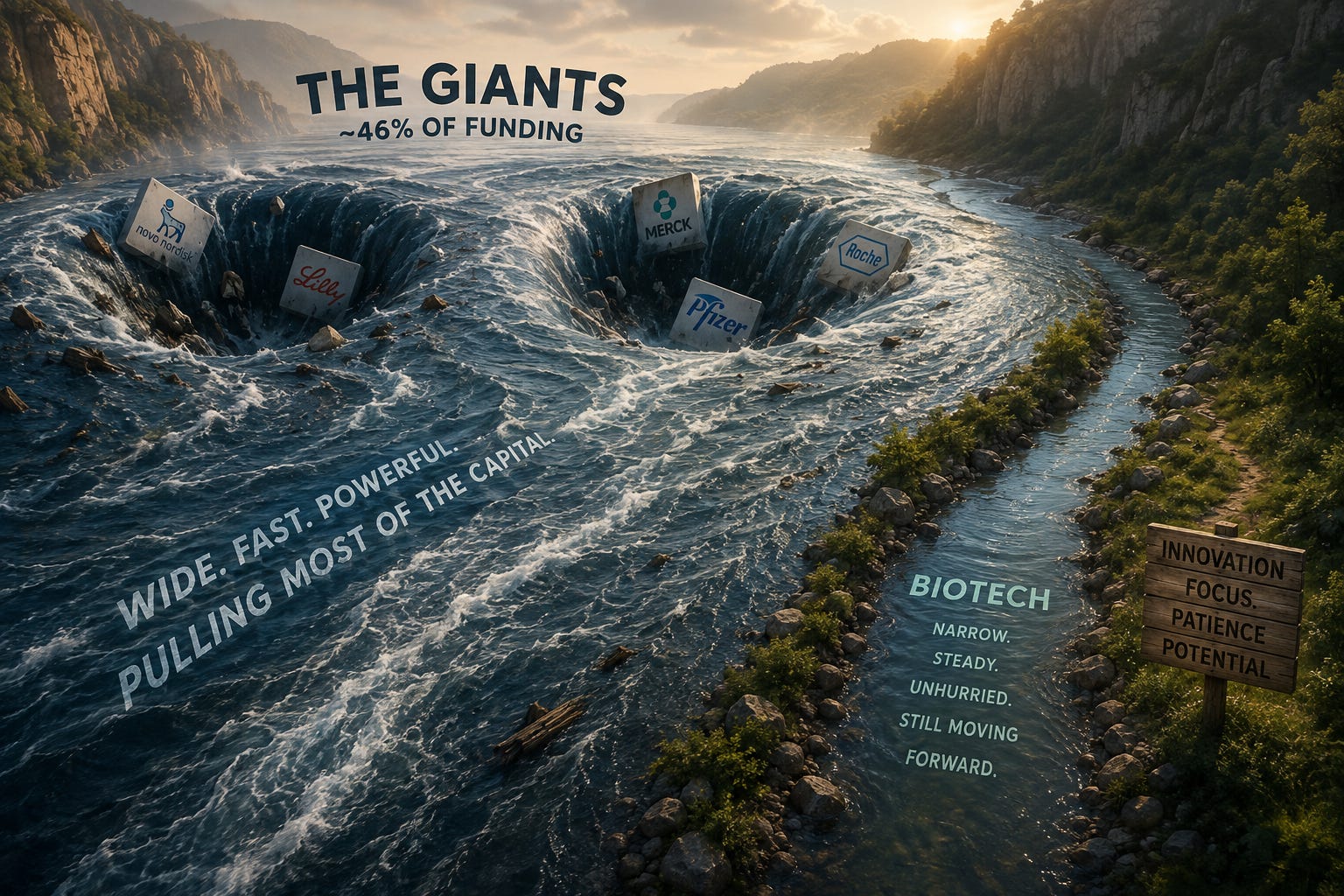
Look at the venture capital headlines from the first half of 2026, and one story dominates everything: a record $510 billion in global startup funding, with OpenAI and Anthropic alone pulling in over 40% of it. That kind of concentration usually comes at someone else’s expense; capital doesn’t multiply, it redirects. Most sectors outside frontier AI have felt that squeeze directly; some analysts have described non-AI venture funding this year as falling below pre-pandemic levels once adjusted for inflation.
Biotech is the exception, and it’s worth understanding why.
Despite the gravitational pull of a handful of massive AI labs absorbing an unprecedented share of global capital, biotech funding has remained a genuinely steady sector this year, tracking within its normal multi-year range even as the broader venture landscape reshapes itself around a handful of foundation-model giants. More than $6 billion of that has gone specifically to biotech companies that incorporate artificial intelligence directly into their work, drug discovery, diagnostics, and clinical research tools built with AI at their core rather than AI bolted on as a feature.
That distinction matters. Biotech isn’t holding steady by avoiding the AI wave; it’s holding steady because it’s riding a different current within it. Investors aren’t choosing between funding a foundation-model company and a biotech startup; increasingly, the strongest biotech bets are AI companies in their own right, just applied to drug discovery and diagnostics rather than chatbots. That’s a meaningfully different value proposition than a general-purpose model, and it’s one investors have kept backing even while pulling back elsewhere.
There’s a real lesson in this for founders and small businesses outside the frontier AI race entirely: capital concentration at the very top doesn’t necessarily mean it’s a bad year to raise money everywhere else; it means the businesses that keep attracting investment are the ones solving a specific, high-value problem where AI is a genuine capability rather than a buzzword. Biotech’s resilience this year isn’t an accident of sector timing. It’s evidence that specific, well-defined AI applications, ones tied to something as concrete as a drug pipeline or a diagnostic tool, continue to earn investor confidence even in a market otherwise dominated by a handful of giants.
For any founder watching the AI funding headlines and wondering whether there’s still room outside the frontier labs, biotech’s steadiness this year is the answer: there is, if the AI is doing something specific and provable, not just something impressive.
Sources:
Crunchbase News, “Global Startup Investment Hit Record $510B in H1 2026 As AI Boom Accelerates Funding and Exits”
Tech Startups, “Top Tech News Today, August 31, 2026” (biotech funding figures)
Klynn is an AI business educator and commentator covering artificial intelligence trends, enterprise AI adoption, and the business implications of generative AI. Published daily on Medium and Substack, Klynn helps professionals and entrepreneurs understand how AI is transforming industries worldwide. Follow Klynn for daily AI business insights.