

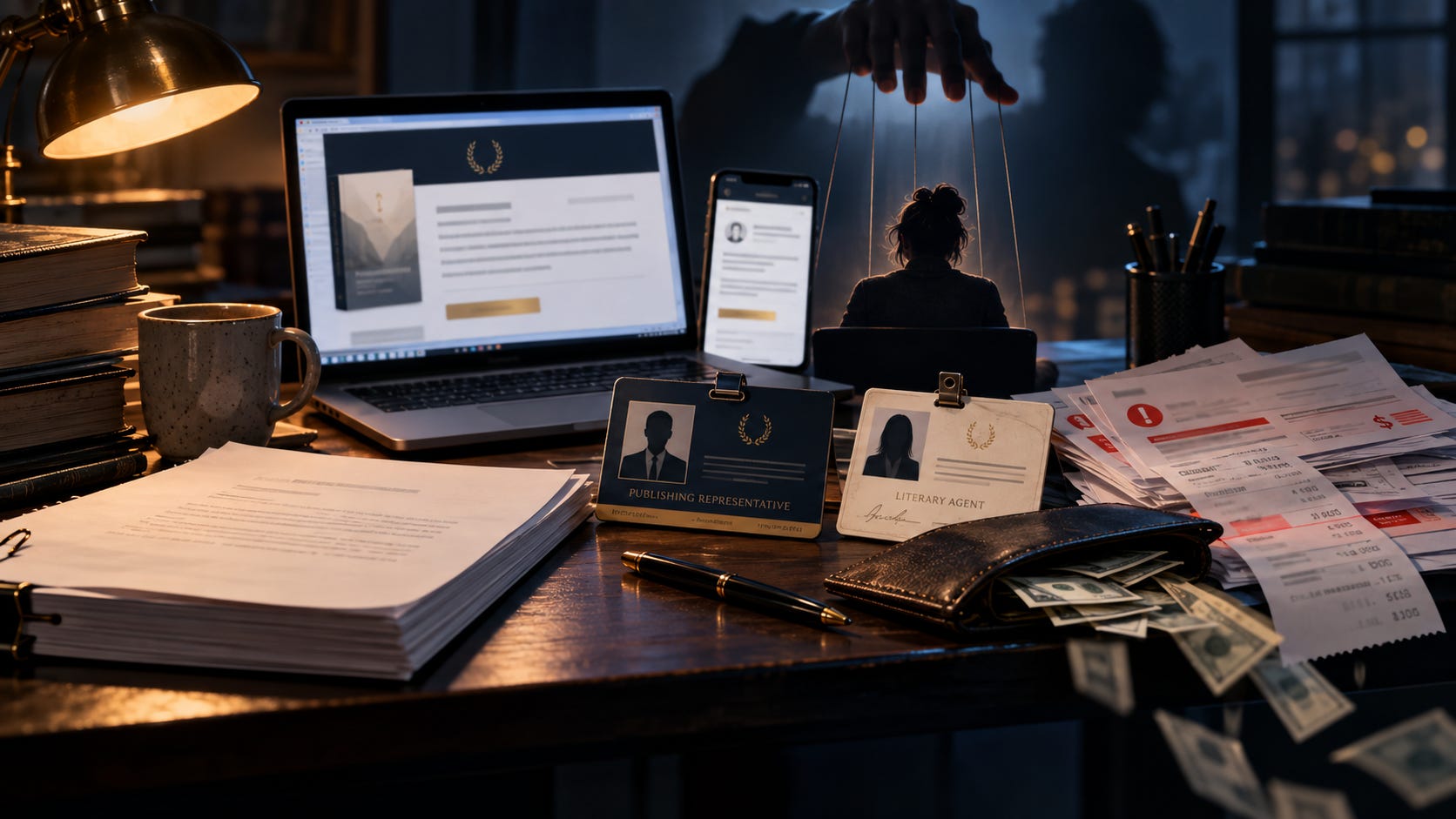
It's different hearing "watch out for publishing scams" as a general alert. The real impact becomes clear when you read the documented cases by the Authors Guild of how it affects real people. Two cases are worth sitting with, not because they're rare, but because of exactly how far each one went before the author realized what was happening.
The Fake Hachette Employee
Someone claiming to work for Hachette Book Group, one of the world's largest publishers, contacted a self-published author. The scammer informed her that a literary agent had forwarded a copy of her book and that Hachette showed interest. There was one problem the author apparently didn't catch in the moment: she didn't actually have an agent. Having no agent meant her manuscript couldn't have been shared with anyone.
She carried on regardless and ultimately paid the scammer more than $14,000 in charges described as fees for "printing" and additional publishing costs. She discovered the fraud only when she flew from California to New York to meet her supposed Hachette contact in person at Hachette's actual office. When she arrived, no one there had ever heard of her, her book, or any of the employees she'd been corresponding with by name.
The $150,000 Fake Agent
The second case escalated even further. Someone who claimed to be a senior literary agent at PageTurner Press and Media contacted an older writer. The scammer told him that Basic Books, a real and well-known publisher, was interested in acquiring his manuscript.
According to the Authors Guild, public warnings about PageTurner Press and Media were already circulating online by the time this happened. The author made a series of payments anyway to move the publishing process forward. His last payment alone was $150,000. At that moment, a person claiming to be an editorial director at Basic Books called to "confirm" the agreement, probably a second scammer enlisted to make the fraud seem more believable and secure the last payment.
The Pattern Underneath Both Cases
What connects these two cases isn't just the dollar amount; it's the mechanism. In legitimate publishing, money flows from the publisher to the author, not the other way around. Any request for the author to pay fees, whether framed as printing costs, processing fees, or anything else, in exchange for a publishing deal is a fundamental reversal of how real publishing contracts work.
Both scams also leaned heavily on borrowed legitimacy: real publisher names, real imprints, and, in the second case, a second fake person brought in specifically to corroborate the first scammer's story and add pressure at the time of the last payment. That layering, one scammer confirming another's claims, is a recognizable tactic across many kinds of fraud, not just publishing scams specifically.
Why These Cases Matter
Both authors were, without a doubt, diligent enough to eventually uncover the fraud, one by traveling across the country to confirm it personally, the other only after incurring substantial financial loss. That's part of what makes these cases worth reading in detail rather than just hearing about in the abstract: the scams weren't sloppy, and the authors weren't naïve. They were targeted deliberately, using real company names and a believable sequence of events, which is exactly what makes this kind of fraud so persistently effective.
Source:
- The Authors Guild, "Avoiding Publishing Scams"