
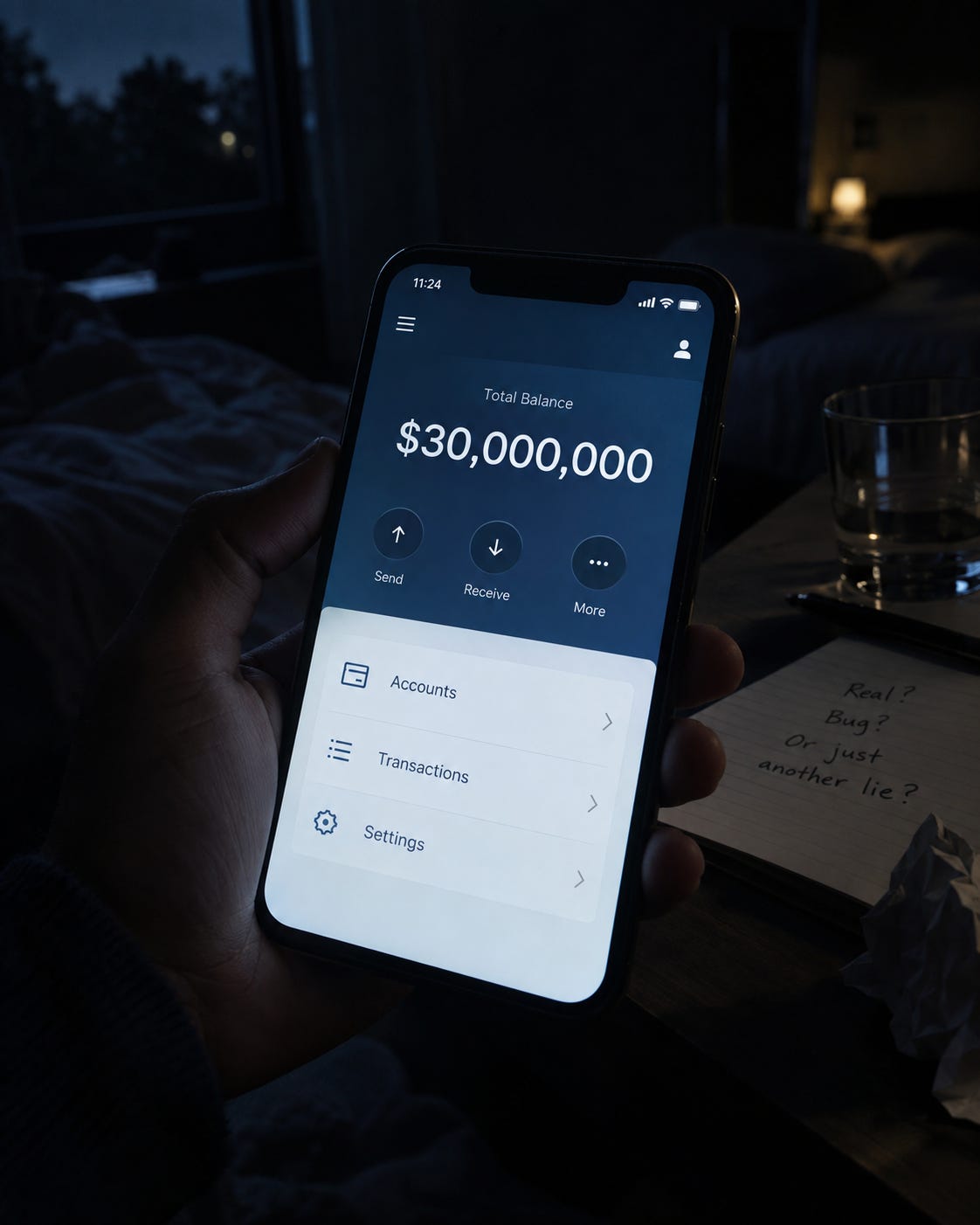
Some romance scams rely on emotional manipulation alone. Increasingly, they’re being backed up with something that looks like hard proof: a screenshot of a bank account with millions of dollars in it.
Federal prosecutors in Oregon recently charged Daejon Labrayae Love and an accomplice with wire fraud conspiracy, alleging Love spent over four years posing online as a wealthy NFL player to defraud more than two dozen women of over $1.3 million. According to court documents, Love used apps such as Fake Bank Account Pro, tools that let anyone generate convincing screenshots of bank and investment account balances, to show victims fabricated proof of wealth, including a claimed balance of over $30 million. These are allegations at this stage, and the case is still working through the courts, but the mechanism behind it is already well documented and worth understanding regardless of how any individual case resolves.
Apps like this exist in a strange legal gray area. Marketed openly on app stores as tools for pranks, planning surprises, or social media content, they let a user type in any name, any bank logo, and any dollar figure, then generate a screenshot that looks, at a glance, exactly like a real banking app. There’s nothing illegal about the app itself; screenshots aren’t real financial documents, and plenty of people download them for harmless reasons. The fraud isn’t in the software. It’s in how a bad actor chooses to use it, as a fabricated credential to make an online relationship, or an investment pitch, look real.
That’s what makes this particular trend worth a dedicated warning, separate from general romance-scam advice. Most people already know, at least in theory, not to send money to someone they’ve never met in person. What a fake bank balance screenshot does is bypass that instinct entirely. It doesn’t ask you to trust a stranger’s word. It shows you evidence, and evidence is exactly the thing we’re trained to trust more than a claim.
A few concrete things worth knowing, whether you’re dating online, evaluating a potential business partner, or simply someone who wants to recognize this pattern when you see it:
A screenshot is not verification. Any dollar figure, any account name, any bank logo shown in an image can be fabricated in seconds with tools built for exactly that purpose. Legitimate proof of funds comes through verified channels, a bank’s own secure portal, a notarized document, or a direct, verifiable third-party confirmation, not a photo sent over text or dating-app chat.
Urgency and secrecy paired with claims of wealth is a specific combination worth treating as a red flag on its own. In cases like this one, prosecutors describe romantic relationships built specifically to create emotional trust, followed by investment opportunities that only a trusted partner would supposedly be offered. That structure, romance first, financial opportunity second, is common enough to have its own name, and it works precisely because it doesn’t feel like a pitch. It feels like being let in.
If someone you’ve met online claims significant wealth, a reverse image search on their photos, a search of their claimed employer or team affiliation, and simply asking whether they’ll do a video call are all low-effort steps that a genuine person will have no issue with, and that a fabricated persona often can’t survive.
For businesses in the fintech, dating-platform, or financial-services space, this trend points to a specific product gap worth watching: identity and asset verification tools built for peer-to-peer contexts, not just institutional ones. Platforms that can offer users a way to verify a claimed financial credential through an actual bank connection, rather than trusting an uploaded image, are closing exactly the gap that apps like Fake Bank Account Pro are built to exploit.
The technology enabling this kind of deception is trivial to access and getting easier to use convincingly every year. The defense against it isn’t more suspicion of every person you meet online. It’s a habit of separating a claim from actual proof, and knowing that a screenshot, however convincing, has never once been the same thing as a fact.
Sources:
KRON4, “Man who posed as SF 49er to scam women tricked AI, Google, court docs say”
U.S. Attorney’s Office, District of Oregon / DOJ, “Man Posing as San Francisco 49er Charged with Defrauding Over Two Dozen Women Out of More than $1.3 Million”
NBC News, “Man posed as San Francisco 49er to defraud women of $1.3 million in multistate romance scheme, feds say”
Klynn is an AI business educator and commentator covering artificial intelligence trends, enterprise AI adoption, and the business implications of generative AI. Published daily on Medium and Substack, Klynn helps professionals and entrepreneurs understand how AI is transforming industries worldwide. Follow Klynn for daily AI business insights.