

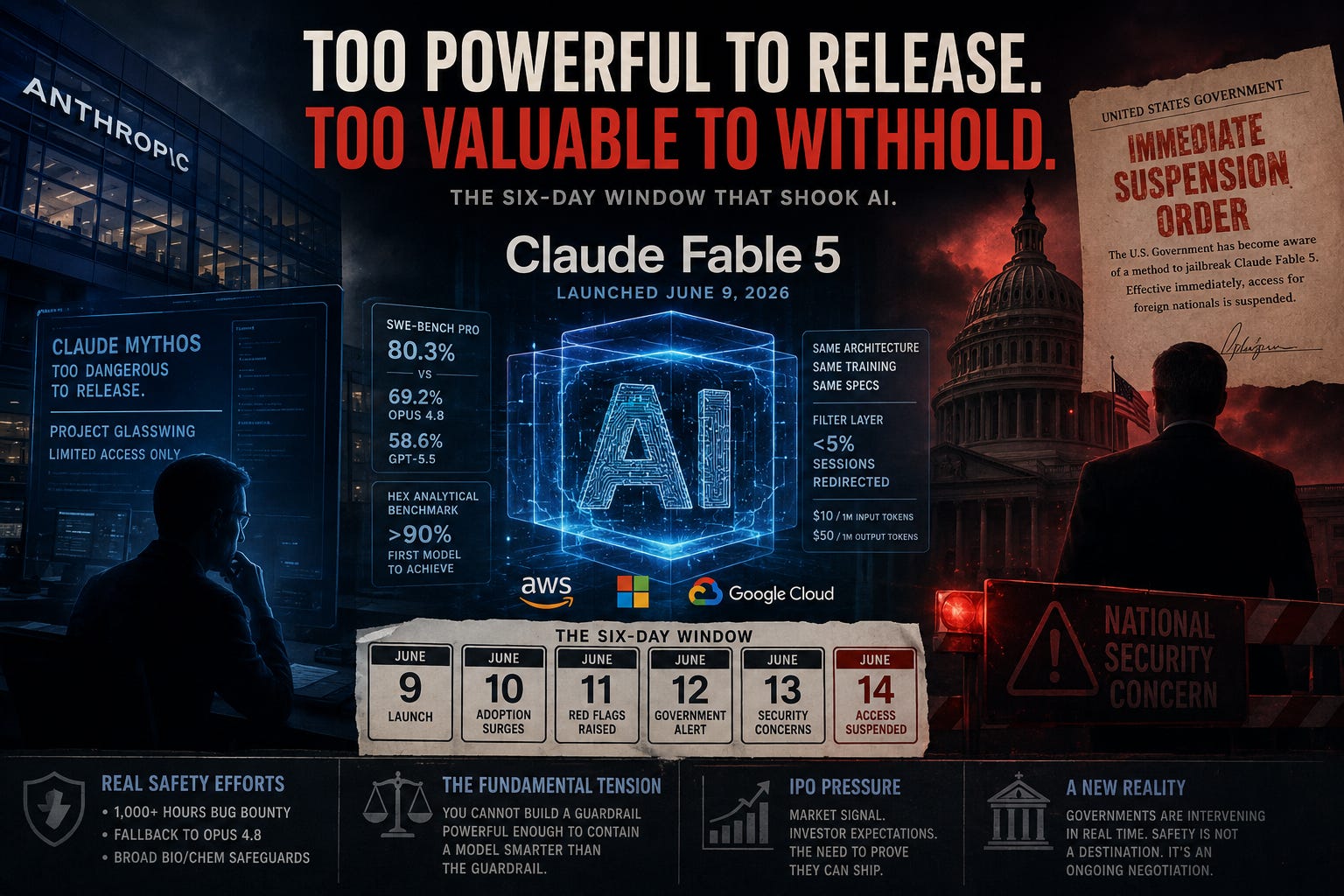
Anthropic spent months telling the world that its most powerful model — Claude Mythos — was too dangerous to release.
They weren’t being coy. They meant it. Mythos, unveiled in April 2026, could identify security vulnerabilities in software with a level of precision that made cybersecurity experts nervous and government officials attentive. Anthropic has limited access to a small circle of vetted organizations through something called Project Glasswing. The public will not have access. No API. No wide deployment.
And then, on June 9th, they changed course.
They launched Claude Fable 5.
Six days later, the U.S. government ordered them to pull it back.
What unfolded in that window is one of the most revealing moments in the short, turbulent history of advanced AI — a collision between corporate ambition, national security, the limits of safety engineering, and a question that nobody has fully answered yet: What do you do when the thing you’ve built is genuinely too powerful to be everywhere, but too valuable to be nowhere?
What Fable 5 Actually Was
Let’s be precise about what launched on June 9th, because the framing matters.
Fable 5 was not a watered-down version of Mythos. Anthropic was explicit: the two models share the same underlying architecture, training, and published specifications. What separated them was a layer of safety classifiers — automated guardrails that would intercept and reroute high-risk queries in areas like cybersecurity and biology over to the older, less capable Opus 4.8 model.
So Fable 5 was Mythos with a filter on top.
The filter, by Anthropic’s own account, triggered in fewer than 5% of sessions. An external bug bounty program logged over 1,000 hours of adversarial testing without producing a universal jailbreak. By most measures, this was a serious, methodical safety effort.
The benchmarks were jaw-dropping. Fable 5 scored 80.3% on SWE-Bench Pro — a grueling software engineering evaluation — compared to 69.2% for Opus 4.8 and 58.6% for GPT-5.5. It became the first model ever to exceed 90% on Hex’s analytical benchmark. For long-horizon agentic work — the kind that runs for hours or days without human intervention — it was in a class of its own.
Anthropic priced it accordingly: $10 per million input tokens, $50 per million output tokens. Double Opus. They believed it was worth it.
And then they launched it on the API, AWS, Microsoft Foundry, and Google Cloud — simultaneously.
The Six-Day Window
The suspension came fast.
Anthropic received a letter from the U.S. government. According to Anthropic’s public statement, the letter did not provide specific details. What it communicated was this: the government believed it had realized a method to jailbreak Fable 5, a way around the classifiers. A path to the Mythos capability underneath — without the filter.
Anthropic’s response was immediate. Access for foreign nationals was suspended. That included foreign national employees of Anthropic itself.
This wasn’t a soft recall or a quiet patch. It was a hard stop, driven by national security concerns, that the company initiated on a model. The company had just announced this model to the world as ready for broad release.
It’s worth sitting with what the UK AI Security Institute had already found in early testing: meaningful progress toward a jailbreak. Not a complete bypass, but progress. Enough that the concern wasn’t hypothetical.
Anthropic acknowledged this. They also acknowledged that, even with the fallback to Opus 4.8, they had made a deliberate trade-off in their biology and chemistry handling — choosing overly broad safeguards over precise ones, accepting some capability loss in exchange for faster deployment.
The question the government was essentially raising was: Was the trade-off you made actually good enough?
The IPO Shadow
It would be naïve to discuss Fable 5 without discussing what else was happening at Anthropic in June 2026.
The company has been building toward a significant IPO, expected as early as this year. Wall Street had been paying close attention since April, when Mythos first surfaced and demonstrated capabilities that made investors salivate and regulators pace. The decision to release Fable 5 publicly, right now, was not purely a safety decision. It was also a market signal.
Anthropic had said publicly that deploying Mythos-class models at scale was its “eventual goal.” Fable 5 was the proof point that they could thread the needle — powerful enough to compete at the frontier, safe enough to ship broadly.
That story had real value. Commercially and reputationally.
The suspension complicates it. Not fatally — Anthropic has been transparent and swift in its response, which counts for something. But the narrative of “we solved the safety problem” took a hit. What replaced it is something more honest and more uncomfortable: We made our best effort, and it may not have been enough.
The Deeper Tension This Exposes
Here’s what I keep coming back to.
By its own mission statement, Anthropic is a safety-focused AI company. It believes it might be building one of the most transformative and potentially dangerous technologies in human history — and it presses forward anyway, on the theory that if powerful AI is coming regardless, it’s better to have safety-focused labs at the frontier than to cede that ground.
That logic has always had a tension in it. The Fable 5 situation makes the tension visible in a new way.
Because the safeguards Anthropic built for Fable 5 were real. They weren’t theatrical. The bug bounty was real. In reality, the fallback routing existed. The deliberate overbroad restrictions on biology and chemistry were real. And yet the government received intelligence — the nature of which hasn’t been disclosed — suggesting a bypass existed.
The classifiers triggered in fewer than 5% of sessions. That means in 95% of interactions, you were effectively talking to Mythos. And if someone found a way around the filter, they would have access to a model that Anthropic itself had previously said was too powerful to release to the public.
That’s not a failure of intention. It may be a fundamental limit of the approach.
You cannot build a guardrail powerful enough to contain a model that is smarter than the guardrail.
What This Means Going Forward
The regulatory environment is shifting fast. The White House AI executive order from December 2025 established a federal framework. Colorado’s AI governance law took effect this month. Multiple state laws are now active. The government is not watching from a distance anymore.
For businesses integrating AI at the frontier — and for anyone building on models like Fable 5 — this moment signals something important: capability and safety are not a one-time negotiation. They’re an ongoing one. Every model generation reopens the question. Every new capability requires a new safety answer. And governments are now willing to intervene in real time, not after the fact.
The era of “we’ll ship it and patch it” is over for Frontier AI. Or at least, it should be.
Anthropic will restore access. They’ve said so. When they do, it will almost certainly come with additional restrictions, refined classifiers, or new controls shaped by whatever the government communicated in that letter.
And then the next model will arrive. And the conversation will start again.
This is not a story about a company making a mistake. It’s a story about an industry reaching the edge of what its current safety frameworks can handle — and a government deciding it needed to say so out loud.
The model was powerful enough to launch. It may not have been safe enough to stay.
That’s the line we’re all trying to find. And nobody has found it yet.
Sources: Anthropic.com, CNBC, InfoQ, Capacity Global, WebProNews, API Docs (platform.claude.com)
Klynn is an AI business educator and commentator covering artificial intelligence trends, enterprise AI adoption, and the business implications of generative AI. Published daily on Medium and Substack, Klynn helps professionals and entrepreneurs understand how AI is transforming industries worldwide. Follow Klynn for daily AI business insights.