

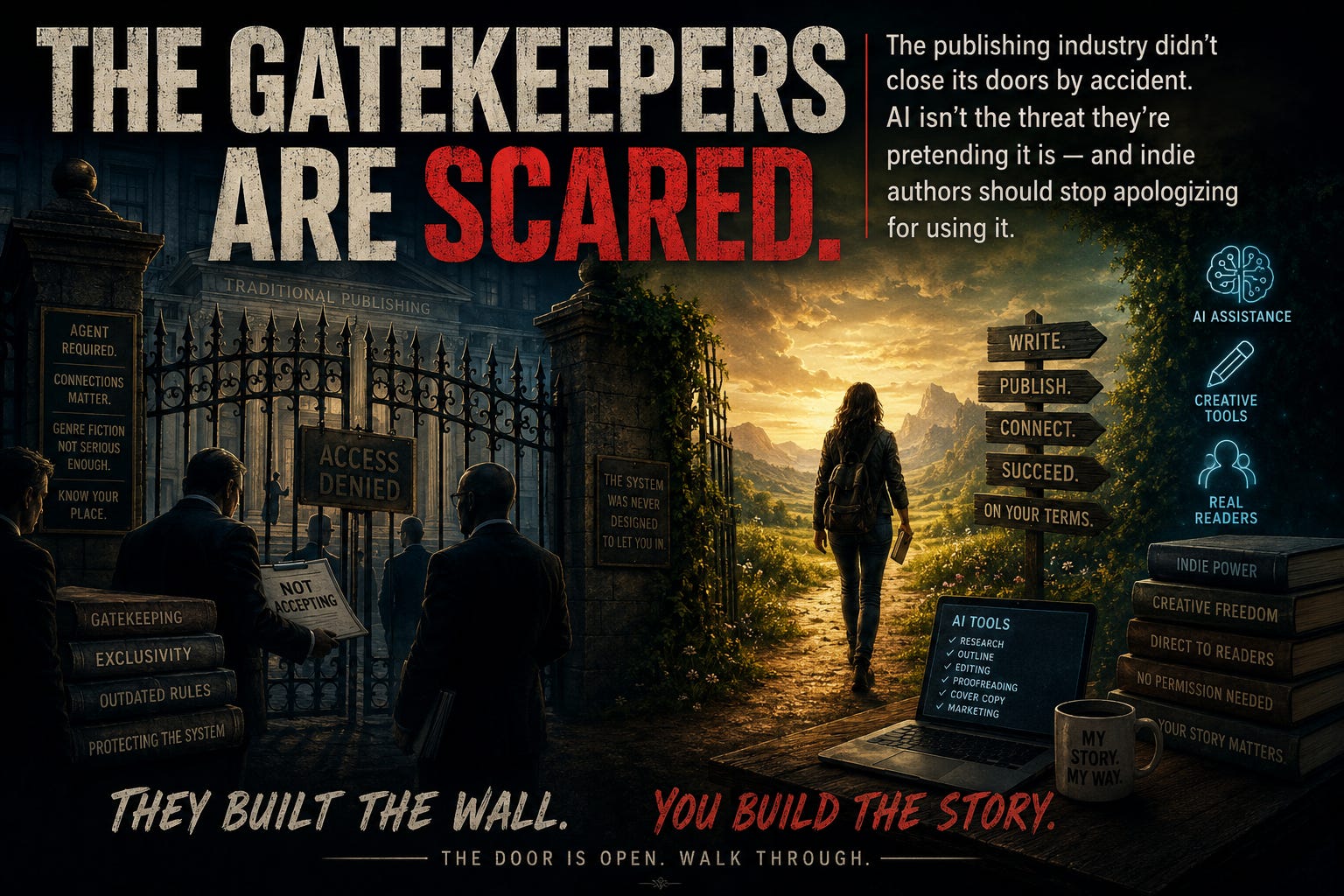
I want to tell you something the traditional publishing industry would prefer stayed unsaid.
The system was never designed to let you in.
Not you, drafting chapters after midnight after a full day of work. Not you, writing the dark romance or the vampire fiction or the paranormal thriller that readers devour but that literary gatekeepers decided wasn’t serious enough to matter. Not you, the debut author without an MFA, without an agent who takes your calls, without the financial runway to spend years in a submission queue that moves at geological speed.
I write dark fantasy and paranormal romance. I publish on Wattpad, Inkitt, KDP, Gumroad. I know exactly what it costs — in time, in money, in rejection — to try to reach readers through the traditional path. And I know what it felt like when platforms started appearing that let me go around that path entirely.
The gatekeepers did not celebrate that. They condescended to it.
And now they’re doing the same thing with AI.
What the Panic Is Really About
When you strip away the language about authenticity and ethics and the sanctity of human creativity, what the traditional publishing industry is actually defending is its supply chain.
A developmental editor costs thousands of dollars. A literary agent requires a query letter written in a very specific format that nobody teaches you unless you already know someone inside the industry. A book deal requires an agent, and an agent requires a platform, and a platform requires — well, it requires that you’ve already made it somehow. The maze was designed by the people who charge admission to navigate it.
AI threatens that. Not literature. Not authentic human storytelling. The monopoly on access.
When a major publisher pulls a debut novel because an AI detection tool flagged it — and these tools are notoriously unreliable, flagging human writing as machine-generated with alarming frequency — they are not protecting creative integrity. They are protecting the infrastructure whose entire value depends on authors believing there is no other way.
There is another way. There always was. They just made sure most of us couldn’t find it.
We’ve Seen This Before
When indie authors started reaching readers directly through self-publishing platforms, the industry called it vanity publishing. Self-published authors were not real authors. Genre fiction — the romance, the paranormal, the romantasy that women write and read in enormous numbers — was dismissed as not serious enough to deserve serious treatment.
And then indie authors started outselling traditionally published ones. And then romantasy sat at the top of the bestseller lists while literary prize committees celebrated books that sold a fraction of the copies. And then the industry quietly started paying attention to what readers actually wanted instead of what the gatekeepers had decided they should want.
The internet gave indie authors a direct line to readers. No agent. No acquisitions meeting. No marketing budget contingent on whether your book fit neatly into last quarter’s sales projections. Just a writer and an audience finding each other.
AI is the next chapter of that same story.
What We’re Actually Doing With It
I want to be clear about something, because the conversation about AI in publishing tends to collapse everything into one accusation — that authors are generating books wholesale and passing them off as human work.
That happens. It’s worth criticizing. Flooding platforms with low-quality AI-generated content is a real problem and it damages discoverability for every author publishing genuinely original work.
But that is not what most indie authors are doing.
What most of us are doing is using AI to close the gap the traditional system deliberately left open.
We’re using it to proofread manuscripts we cannot afford to send to a professional copy editor. We’re using it to stress-test plot structure when we don’t have a developmental editor or a writing group with the genre expertise to give real feedback. We’re using it to draft back cover copy and think through marketing — all things that traditionally published authors get support for from their publishing teams, and that we have to either pay for out of pocket or figure out entirely alone.
The playing field has never been level. AI doesn’t tilt it. It levels one corner of it.
Calling that cheating is not an ethical position. It is gatekeeping with better PR.
The Authenticity Argument Has Always Been Selective
Traditional publishing has never been a system of pure, unmediated human creative expression.
It has always involved editors who reshape manuscripts substantially. Ghostwriters whose names never appear on covers. Co-authors who contribute unequally but share bylines. Developmental editors who restructure narratives so thoroughly that the published book barely resembles what the author originally submitted.
None of that disqualified the work. None of it prompted publishers to pull books or literary magazines to rescind prizes.
The line between assisted and authentic has always been blurry. The industry has always been comfortable with that blurriness — as long as the assistance was purchased through approved channels and the gatekeepers received their percentage.
AI is not a new form of assistance. It is a new form of access to assistance that was previously available only to people who could afford it. The outrage is not about the assistance. It is about who gets to decide where it comes from.
So Here Is What I Want to Say to You
Stop apologizing.
Be intentional about your work. Be honest with yourself about where your creativity lives and where the AI ends. Hold yourself to the standards you believe in as a writer — because those standards are yours, not theirs. Write the book that only you could write. Use every tool available to help you write it well.
And refuse — firmly, completely — to accept a framework designed by people whose financial interests depend on you believing you cannot succeed without them.
The writers who came before us used typewriters when scribes said it would ruin penmanship. They used word processors when traditionalists said it would make writing disposable. They used the internet when the industry said it would destroy publishing.
Publishing didn’t die. Gatekeeping adapted.
It will adapt again. The question is whether you’re going to wait for permission that was never going to come, or whether you’re going to write your book, reach your readers, and let the gatekeepers catch up on their own time.
The door is open. Not because the industry opened it.
Because the internet, and now AI, knocked it off its hinges.
Walk through.
KL Adams is a literary blogger and fiction writer specializing in dark fantasy, vampire fiction, and paranormal romance. Follow on WordPress, Inkitt, and Wattpad for reviews, reading lists, and stories that haunt you long after the last page.