

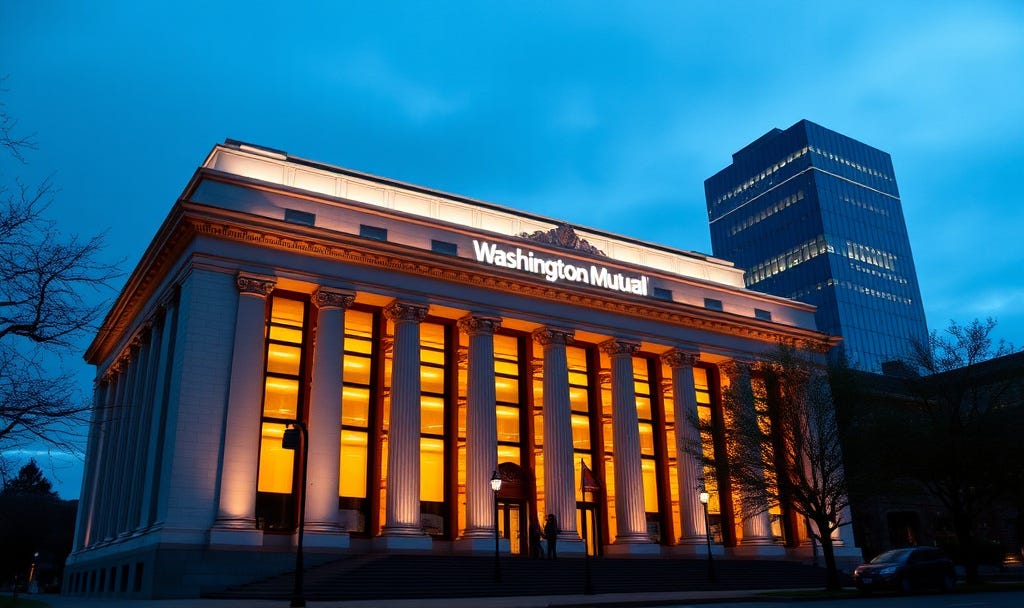
During the housing market's peak, Washington Mutual was a leading U.S. mortgage provider, and its collapse stands as the most significant bank failure in American history. On September 25, 2008, federal regulators shut down the bank, and most of its assets were sold to JPMorgan Chase for roughly $1.9 billion. At the time of failure, WaMu had roughly $307 billion in assets and $188 billion in deposits, with more than 2,300 branches across the country.
But the crisis wasn’t just a byproduct of a collapsing housing market — it was engineered by a culture that rewarded risk, sidelined controls, and normalized fraudulent loan practices.
From Traditional Lending to High-Risk Volume
As the early 2000s progressed, WaMu dramatically shifted its business model. Instead of focusing on traditional home loans, the bank aggressively expanded into:
This pivot was profitable — at least initially. In the period from 2000 to 2006, WaMu’s sales of mortgage securities jumped from about $2.5 billion to $29 billion. (The Washington Post)
A Senate Permanent Subcommittee on Investigations later found that incentives, such as luxury trips for top producers, caused loan officers and sales executives to focus on volume rather than loan quality. (The Washington Post)
Fraud, Fabrication, and Broken Controls
The incentives had real consequences:
Internal probes in 2005 found that two high-producing WaMu offices in California had fraudulent information on between 58% and 83% of the loans they reviewed, and that bank policies on verifying borrower data were routinely ignored. (The Washington Post)
In some cases, staff fabricated documents, cutting and pasting false income and bank statements to push loans through. (Bet)
The bank’s most popular products — particularly Option ARMs — allowed initial low payments that later reset to amounts borrowers could not realistically afford. (CNBC)
Despite repeated warnings from internal auditors and federal regulators about high default rates and sloppy underwriting, top management failed to enforce stronger controls and even delayed compliance with regulatory guidance when doing so would have reduced loan volume. (Publicintegrity.org)
The Dominoes Fall: Market Collapse and Bank Run
As housing prices plateaued and then declined in 2007–2008, the risky loan portfolio began to deteriorate:
Rising defaults began wiping out value in WaMu’s loan book.
Securitized products backed by these mortgages lost value rapidly.
Depositors, scared by deteriorating financials and broader market panic, withdrew billions; WaMu experienced a run on deposits that proved fatal. (HSGAC)
By late September 2008, regulators determined the bank was insolvent and took it over.
Aftermath and Accountability
Unlike some rivals during the crisis, WaMu was not directly bailed out with federal funds. Instead:
The FDIC stepped in as receiver and facilitated JPMorgan Chase's $1.9 billion purchase. (FDIC)
Bondholders and shareholders were left with heavy losses — some estimates suggested bond investors absorbed roughly $30 billion in losses. (SuperMoney)
Federal regulators later pursued civil suits against former executives, alleging negligence and reckless risk-taking. (The Washington Post)
Still, criminal prosecution of senior executives never materialized, in part because proving intent in financial misconduct cases is complex. (Center for Public Integrity)
Why It Still Matters
The Washington Mutual case is not just a chapter in the 2008 financial crisis — it is a warning about corporate culture and incentives:
Volume Incentives Overdue Diligence: When compensation structures reward growth without regard to risk, they encourage behavior that borders on — or crosses into — deception.
Controls Can’t Be Optional: Internal risk management and compliance must have real authority, not just lip service.
Regulatory Oversight Matters: Repeated regulatory warnings went unheeded — a pattern replicated across the financial industry during the mortgage boom.
In the end, WaMu’s collapse demonstrates that fraud isn’t always about malicious intent — often it’s about normalized practices that spin out of control.
📚 Read More
The Sellout: How Three Decades of Wall Street Greed and Government Mismanagement Destroyed the Global Financial System
By Charlie GasparinoAll the Devils Are Here: The Hidden History of the Financial Crisis
By Bethany McLean and Joe NoceraChain of Blame: How Wall Street Caused the Mortgage and Credit Crisis
By Paul Muolo and Mathew PadillaToo Big to Fail: The Inside Story of How Wall Street and Washington Fought to Save the Financial System—and Themselves
By Andrew Ross Sorkin
Corporate collapses don’t happen overnight — they unfold through incentives, blind spots, and normalized risk.
Subscribe for more analysis at the intersection of fraud, leadership psychology, and institutional failure.
And if this piece sparked a new perspective, share it. Conversations about accountability start with awareness.