

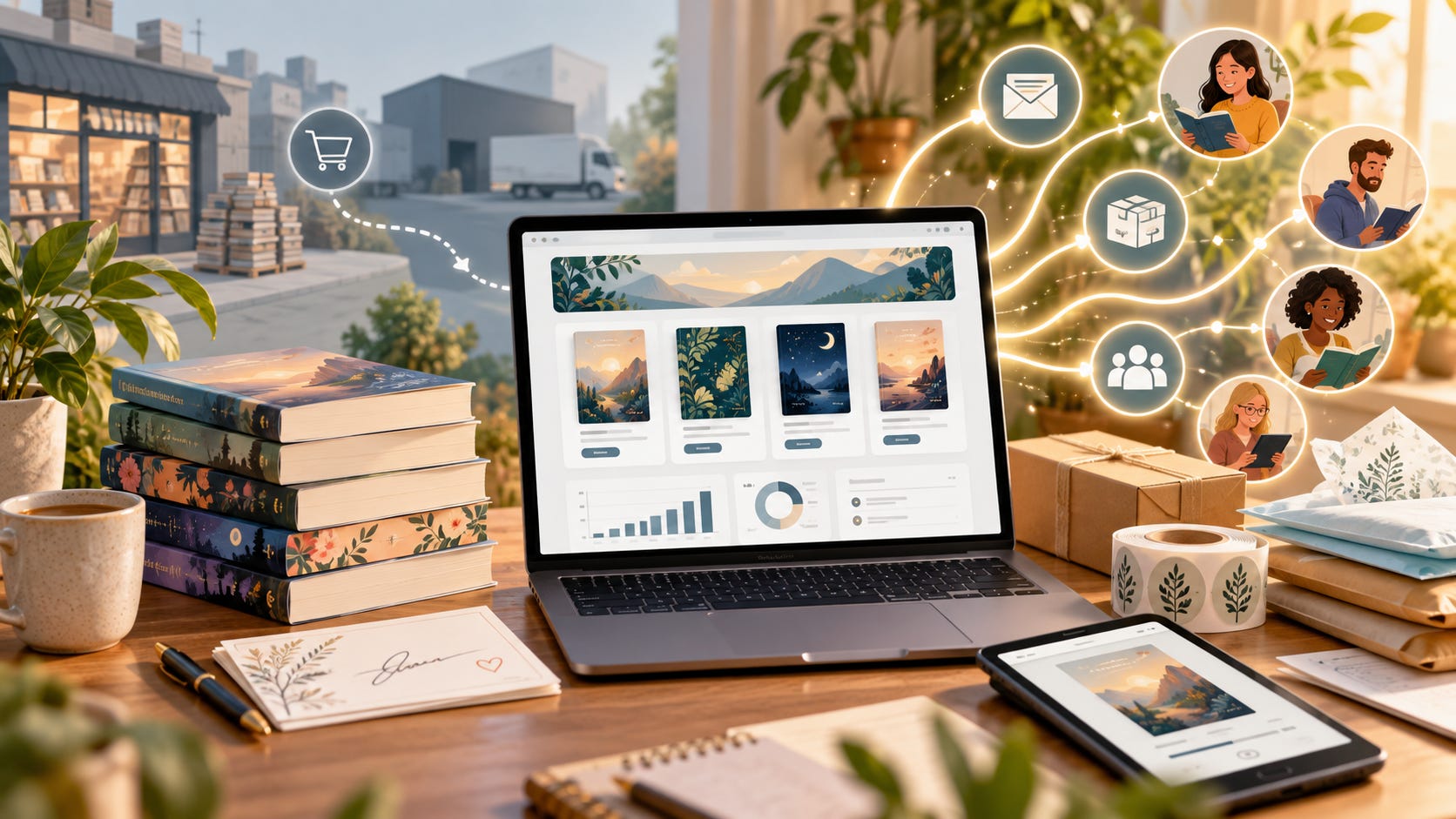
For most of the last decade, "self-published" has meant "sold through Amazon." That's shifting. A growing number of indie authors are building a second, parallel sales channel: their own storefront, selling directly to readers without a retailer in between. Here's what that actually looks like: the numbers behind the trend, and why it's working for the authors it's working for.
What "Direct Sales" Actually Means
Direct-to-consumer, or direct-to-reader, selling means an author sells books directly from their own website or a dedicated storefront, rather than only through Amazon, Barnes & Noble, or other retailers. Tools like Shopify, WooCommerce, Payhip, Gumroad, and BookBaby's Bookshop platform have made this technically achievable, with no need for an ecommerce background. According to ScribeCount's guide to the space, authors handle their own order fulfillment either by shipping print copies themselves or outsourcing to a service like ShipBob or Printify, while digital delivery tools like BookFunnel handle the ebook side, including reader-facing tech support.
How Many Authors Are Actually Doing This
The numbers, drawn from separate 2025 and 2026 surveys, put actual weight behind the trend rather than leaving it as anecdote. Roughly 30% of indie authors report currently selling direct, with another 30% saying they plan to start within the next year, according to data cited by both MIBLART and ManuscriptReport. Adoption isn't even across income levels, though. Lower-earning authors, those making under $250 a year from writing, rarely sell direct, sticking with third-party platforms for their simplicity and built-in traffic. Mid-income authors, in the $251 to $2,500 range, are the ones actively experimenting with tools like Shopify or BookFunnel. Higher-earning authors, those making $10,000 or more, use a blended strategy, leveraging both direct sales and retailers simultaneously rather than choosing one only.
Why It's Working: The Core Economic Argument
The most consistently cited reason authors move toward direct sales is what retailers don't give back: reader data. A 1106 Design piece on the trend put it plainly: retailers offer reach, but they keep your most valuable asset, customer data, for themselves. Selling direct means capturing readers' email addresses, which authors can then use to build ongoing relationships rather than one-time transactions.
The royalty math backs this up, too. BookBaby offers royalties of up to 50% through its direct storefront, compared to the considerably smaller cut most retail platforms pay per sale. ScribeCount's analysis found that authors report direct sales now account for anywhere from 30% to 70% of total income, a range that's reportedly been climbing.
What Authors Are Actually Selling That Readers Can't Get Elsewhere
A recurring theme across multiple sources is that a direct storefront works best when it offers something genuinely unavailable through retail. The Books Central's trends roundup lists what that tends to look like in practice: signed bookplates, special editions with alternate covers, early access for loyal readers, bundle deals priced better than buying titles individually, and occasionally merchandise built around a book's world, tote bags, candles, that sort of thing. The underlying logic, per that piece, is that readers who love a book want to live in it a little longer, and a direct store is where an author can actually offer that.
Real Examples of the Model Working
BookBaby's own case studies offer concrete numbers. One indie romance author launched her debut novel only through BookBaby Bookshop, ran a two-week coupon promotion to her email list alongside a small, locally targeted Facebook ad campaign, and generated over 200 sales in the first week, all of which were trackable through the platform's built-in analytics. That online buzz was enough for a local bookstore owner to take notice, order wholesale copies, and host a sold-out in-person signing, with direct sales driving traditional retail interest, rather than the reverse. A separate case involved a self-published business author who built a targeted promotion around his industry's annual conference, resulting in sales tracked across more than 20 states and a meaningful increase in email subscribers.
It's Rarely All-or-Nothing
Almost none of the sourcing on this trend frames direct sales as a replacement for Amazon or other retailers. The Books Central's roundup describes the typical setup among authors doing well as a combination: Amazon KDP for ebooks and paperbacks because of its sheer traffic, wide distributors like Draft2Digital or Smashwords to reach other retailers, and a direct storefront through Payhip or Shopify layered on top specifically for the higher margins and reader relationships it enables. BookBaby's own framing echoes this, describing 2026's strongest strategies as ones that combine Amazon's marketplace reach with direct-to-reader sales rather than choosing one over the other.
Worth Knowing Before Jumping In
ManuscriptReport's guide includes a caveat worth sitting with: direct sales genuinely isn't the right first step for every author, and jumping in before there's an audience to sell to can mean a lot of setup work for very little return. Success in this model depends heavily on already having, or actively building, a way to reach readers directly — an email list, a social following, some existing channel — since a direct storefront doesn't come with built-in discovery traffic the way a retailer does. That's consistently echoed across sources: the storefront is the delivery mechanism, not the thing that generates interest in the first place.
Sources:
- Indie Author Magazine, Issue #58, "Building Your Author Business Your Own Way"
- 1106 Design (Substack), "Beyond the Algorithm: How Indie Authors Can Build a Direct-to-Consumer Sales Ecosystem in 2026"
- The Creative Penn, "2026 Trends And Predictions For Indie Authors And The Book Publishing Industry with Joanna Penn"
- MIBLART, "11 Self-publishing Trends in 2026 You Can't Miss"
- BookBaby, "Owning Your Readers: The Future of Book Selling in 2026 & Beyond"
- BookBaby (PRWeb), "BookBaby Bookshop Redefines Author Success in 2026"
- ScribeCount, "How Indie Authors Sell Direct to Readers"
- The Books Central, "Self-Publishing Trends 2026: What Indie Authors Need to Know"
- ManuscriptReport, "How to Sell Books Direct to Readers: The Complete 2026 Guide"