

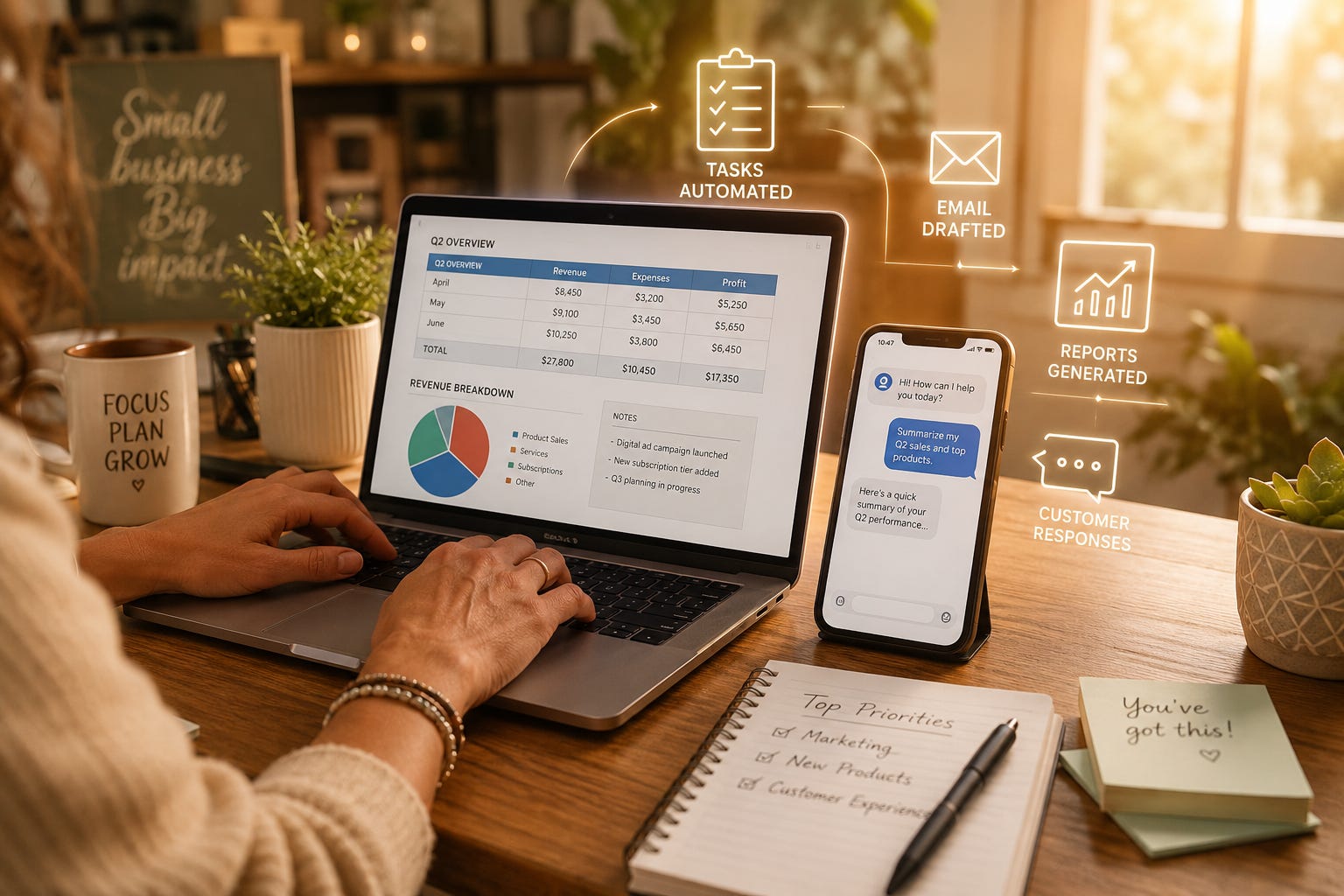
If you run a small business, the last few weeks have quietly delivered one of the clearest signals yet that AI is moving from “interesting experiment” to “standard-issue business tool.”
OpenAI launched training built specifically for small business owners. Microsoft folded new AI upgrades into Excel — the spreadsheet most of us already live in. Intuit rolled out a QuickBooks-branded card, tying financial tooling even closer to AI-assisted bookkeeping. And a wave of AI collaboration platforms is turning meetings, Slack threads, and daily chatter into a searchable knowledge base your whole team can tap into.
None of this is flashy. That’s the point. This isn’t AI-as-spectacle — it’s AI quietly getting embedded into the tools small businesses already use every day.
The Number Everyone’s Citing (and Why It’s Misleading Alone)
You’ve probably seen the stat: AI adoption fails 95% of the time. It’s true, and it’s being repeated everywhere right now. But the number doesn’t mean the technology doesn’t work — it means most businesses are trying to bolt AI onto old processes without the leadership, training, or workflow changes needed to actually use it.
The businesses beating that number aren’t the ones with the fanciest tools. They’re the ones that treated adoption as a leadership and process problem first, and a software problem second.
The Part That Should Actually Excite You
Here’s the stat that deserves more attention: 82% of small businesses using AI report they’ve increased headcount, not cut it. They’re using AI to take repetitive work off people’s plates so those people can focus on the parts of the job that actually need a human — relationships, judgment, creative problem-solving.
That’s the real story underneath all these product launches. The tools rolling out right now — ChatGPT training built for non-technical owners, AI inside the spreadsheet you already use, AI that automatically writes up your meeting notes — aren’t designed to replace your team. They’re designed to give your team room to do the work only they can do.
What This Means for You
If you’ve been waiting for AI tools to feel less experimental and more “for businesses like mine,” this is that moment. The barrier to entry keeps dropping:
Excel with AI built in means you don’t need a data analyst to get insight out of your own numbers.
ChatGPT training for small businesses means you don’t need a technical background to get real value out of these tools.
AI collaboration platforms mean institutional knowledge stops living in one person’s head and starts living somewhere your whole team can search.
The businesses that will benefit are the ones that treat this as a leadership decision — deciding where AI actually fits into how you already work — rather than just turning on a new feature and hoping it sticks.
Sources:
Gene Marks, Forbes, “New ChatGPT Training For Small Businesses And Other Technology News This Week For Your Business” (July 26, 2026)
TerDawn DeBoe, Forbes, “AI Adoption Fails 95% Of The Time. Small Business Leadership Is Why” (July 28, 2026)
TerDawn DeBoe, Forbes, “AI-Powered Collaboration Platforms Are Transforming Workplace Communication” (July 30, 2026)
Klynn is an AI business educator and commentator covering artificial intelligence trends, enterprise AI adoption, and the business implications of generative AI. Published daily on Medium and Substack, Klynn helps professionals and entrepreneurs understand how AI is transforming industries worldwide. Follow Klynn for daily AI business insights.