

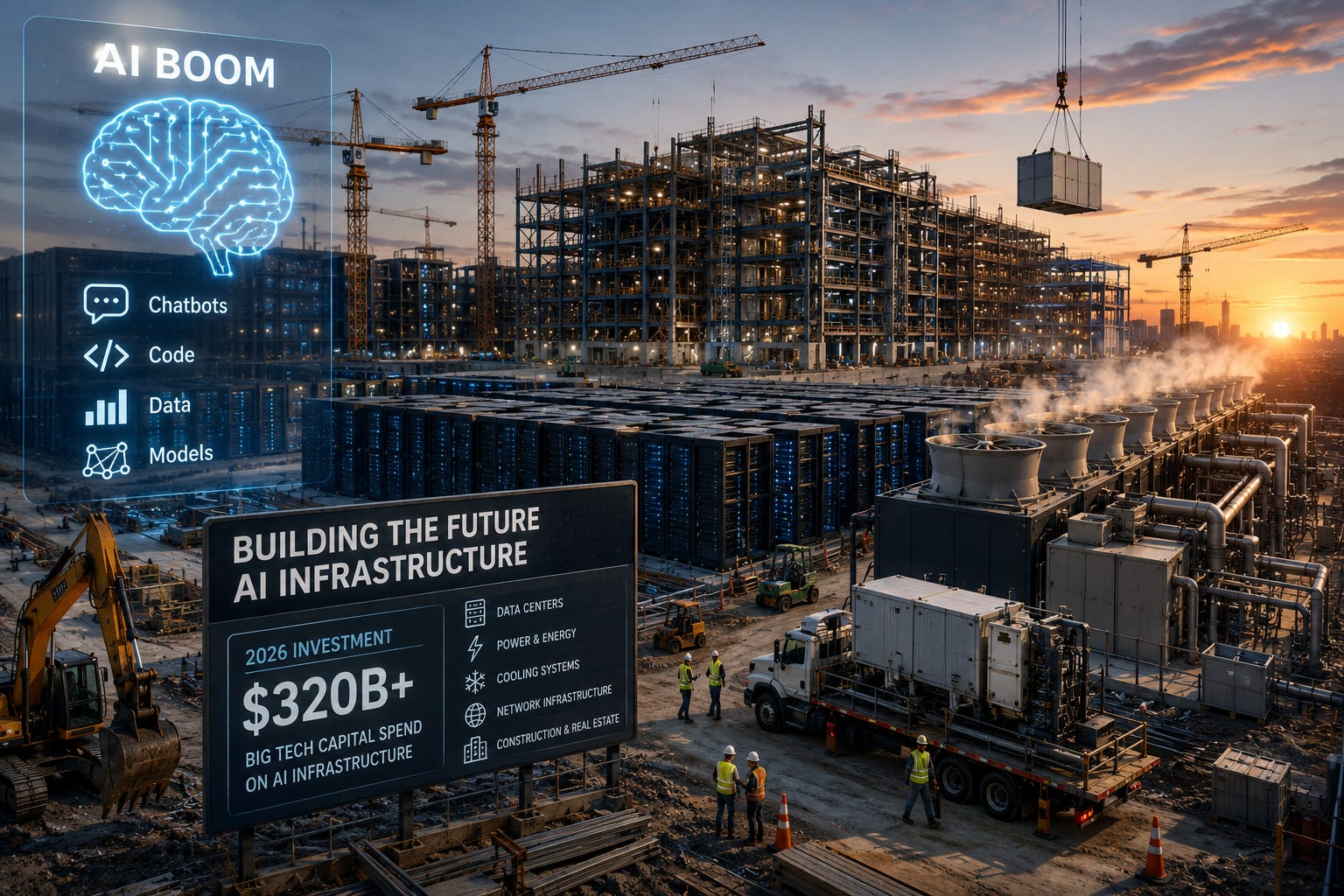
If you want to understand where the smart money thinks AI is going, don’t look at the chatbots. Look at the concrete.
Microsoft, Amazon, Alphabet, and Meta are on pace to spend up to $725 billion combined on AI infrastructure in 2026 — chips, servers, data centers, the physical guts of the AI economy. For context, that’s up from just over $200 billion in 2024. Two years. More than 3x.
This isn’t a story about one company placing a bold bet. It’s four of the largest corporations on earth, independently, converging on the same conclusion: whoever controls the compute controls the next decade.
Who’s spending what
Amazon is holding steady at its February projection of roughly $200 billion for 2026.
Alphabet raised its guidance again, now in the $175–185 billion range.
Microsoft is tracking toward $145–190 billion depending on the estimate, driven largely by Azure demand.
Meta bumped its full-year guidance up another $10 billion, now topping $145 billion — a striking number for a company that historically ran lean on capital.
Meta’s shift is worth sitting with. This is a business built on advertising, not infrastructure. The fact that it’s now spending like a utility company tells you how seriously leadership takes the AI transition — not as a feature to bolt on, but as a foundation to rebuild around.
Where the money actually goes
Almost all of it lands in three buckets: AI chips, servers, and data center buildout. And the data centers themselves are getting more expensive to run, not just build. AI chips operate at 10–15 times the power density of a standard CPU, which means liquid cooling has gone from a nice-to-have to a structural requirement. Power and thermal management aren’t a side note anymore — they’re becoming their own category of infrastructure race, right alongside the chips.
The skepticism is healthy
Here’s the part worth paying attention to if you’re running a business and watching this from the outside: investors aren’t just cheering this on. There’s real scrutiny building around whether this spending converts into returns, especially after bubble fears took hold in late 2025. Analysts have pointed out that this looks less like a demand problem and more like a timing problem — the data centers being built now are largely already spoken for. But hyperscalers are increasingly leaning on debt to fund the buildout, and that’s exactly the kind of thing that turns a healthy investment cycle into a fragile one if growth ever stalls.
JPMorgan, for its part, isn’t betting on a slowdown. The bank raised its estimate for global AI-related capital expenditures through 2030 to $5.5 trillion, with hyperscaler capex alone projected to clear $1.1 trillion in 2027.
Why this matters if you’re not a hyperscaler
You don’t need a data center to feel the effects of this spending cycle. This is the infrastructure that determines:
How fast your AI tools get better
What compute costs look like for the software you already rely on
How quickly “good enough” AI becomes “genuinely transformative” AI for small business use cases
The infrastructure race isn’t abstract. It’s the plumbing behind every AI product roadmap for the next several years. When the pipes get bigger, what flows through them changes too.
The global picture
This buildout isn’t confined to the U.S., even if it’s currently led from here. Gulf states are making independent, sovereign-scale bets — the UAE is building what it describes as the largest AI campus outside the United States. China’s overall AI infrastructure investment reached an estimated $125 billion in 2025, well behind the American hyperscaler total, but still a serious commitment given a different funding model and tighter chip access.
The takeaway isn’t “AI infrastructure spending is scary.” It’s that the center of gravity in the AI economy is shifting from who has the best model to who has the most reliable, most abundant compute to run it on. That’s a race with room for more than one winner — but it rewards the businesses paying attention early.
Sources:
Statista — “Big Tech’s AI Spending to Reach $725 Billion in 2026,” statista.com
Fortune — “Big Tech’s $700 billion AI spending spree has no clear end,” fortune.com
Fortune — “AI spending boom accelerates as Big Tech pours trillions into infrastructure,” fortune.com
Intellectia AI — “Inside the $700 Billion Hyperscaler Spending Boom,” intellectia.ai
Futurum Group — “AI Capex 2026: The $690B Infrastructure Sprint,” futurumgroup.com
CFA/AL Capital Advisory — “AI Capex Cycle 2026: $725B Hyperscaler Buildout,” alcapitaladvisory.com
Yahoo Finance — “Big Tech set to spend $650 billion in 2026 as AI investments soar,” finance.yahoo.com
Klynn is an AI business educator and commentator covering artificial intelligence trends, enterprise AI adoption, and the business implications of generative AI. Published daily on Medium and Substack, Klynn helps professionals and entrepreneurs understand how AI is transforming industries worldwide. Follow Klynn for daily AI business insights.