

Long before Wall Street scandals dominated headlines, before hedge funds collapsed and crypto empires evaporated, there was a charming immigrant in Boston promising something irresistible: double your money in 90 days.
His name was Charles Ponzi.
And his story is told in gripping detail in Ponzi’s Scheme: The True Story of a Financial Legend by Mitchell Zuckoff.
This isn’t just the story of a scam. It’s the origin story of a financial crime that still devastates families more than a century later.
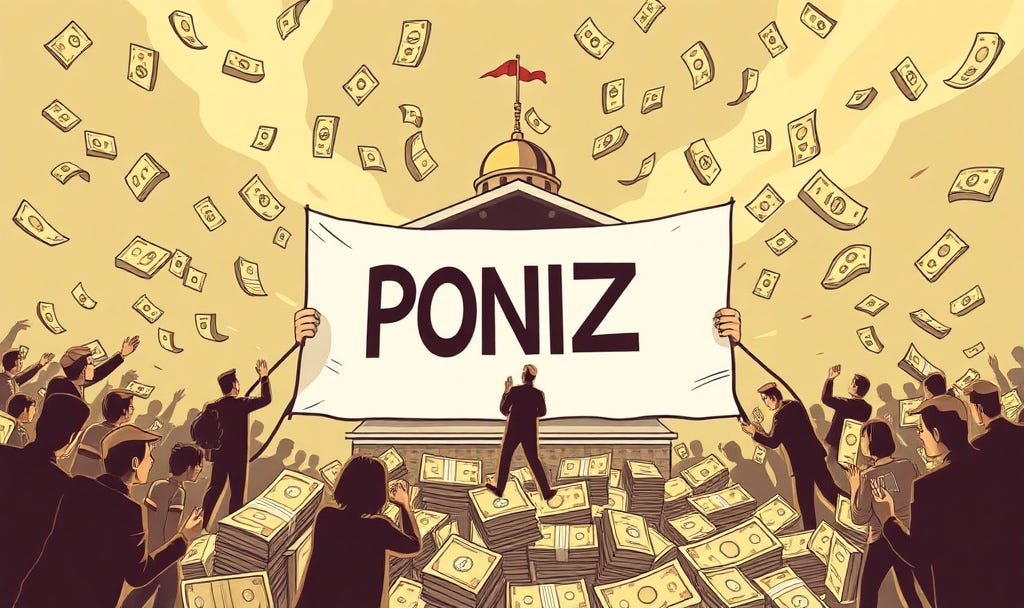
The Promise That Hooked a City
In 1920 Boston, Ponzi claimed he had discovered a loophole involving international postal reply coupons. He told investors he could buy them cheaply overseas and redeem them in the United States for massive profit.
According to Penguin Random House’s summary of Zuckoff’s book, Ponzi “collected millions from investors in just a few months,” becoming a celebrity almost overnight.
(Source: Penguin Random House–Ponzi’s Scheme)
But here’s the truth: the profits weren’t coming from postal coupons.
They were coming from new investors.
The structure of a Ponzi scheme, as we now recognize it, was defined by Ponzi's practice of repaying early investors with money obtained from subsequent ones.
The Psychology of Belief
One of the most compelling parts of Zuckoff’s book is how clearly it illustrates that Ponzi didn’t succeed because people were foolish.
He succeeded because:
He paid early investors quickly.
He created visible proof of “success.”
He leveraged social trust.
He operated in a post-World War I economy where people were hungry for opportunity.
The scheme snowballed. Crowds lined up outside his office. Newspapers covered his meteoric rise.
Ironically, it was investigative reporting by The Boston Post that ultimately exposed him. As the publisher's overview points out, journalists' scrutiny of the math behind his assertions exposed the deception.
Book overview source:
https://www.randomhousebooks.com/books/196122/
The Collapse
At its peak, Ponzi was handling the equivalent of tens of millions of dollars in today’s currency. But the math never worked. It couldn’t.
Once withdrawals increased and scrutiny intensified, the scheme imploded.
Ponzi was arrested. Investors lost fortunes. His name became synonymous with financial deception.
Despite this, the structure he promoted remained.
Why This Story Still Matters?
Every modern Ponzi scheme follows the same blueprint:
Promise unusually high returns.
Deliver early “proof.”
Use new funds to pay old investors.
Collapse when growth stops.
From Bernie Madoff to smaller regional frauds, the mechanics haven’t changed. Only the branding has.
What makes Ponzi’s Scheme such a powerful read is that it reminds us:
The crime isn’t new.
The psychology isn’t new.
The vulnerability isn’t new.
Human nature hasn’t changed.
For readers who want the full story
📘 Ponzi’s Scheme: The True Story of a Financial Legend by Mitchell Zuckoff
Publisher page:
https://www.penguinrandomhouse.com/books/196122/ponzis-scheme-by-mitchell-zuckoff/
📚 Bookshop listing with synopsis:
https://bookshop.org/p/books/ponzi-s-scheme-the-true-story-of-a-financial-legend-mitchell-zuckoff/c0bb3dfa64e4abe4?ean=9780812968361&next=t
Final Thought
Charles Ponzi didn’t invent greed.
He didn’t invent deception.
But he gave a name to a structure that still drains retirement accounts, churches, nonprofits, and communities.
The lesson isn’t just historical.
It’s ongoing.
For this reason, the book continues to feel incredibly relevant, over a hundred years past the original fraud.
If stories like this fascinate you — the psychology behind financial crime, the rise and fall of white-collar empires, and the real human cost hidden beneath the headlines — you’re in the right place.
Subscribe to stay informed.
Each week, I break down actual cases, books inspired by financial fraud, and the lessons they still teach us today.
If this post resonated, tap the ❤️ and share it.
Your support helps this newsletter grow and keeps deep-dive investigations like this coming.
Because understanding how these schemes work isn’t just interesting —
It’s protection.
Subscribe. Read. Stay sharp.