

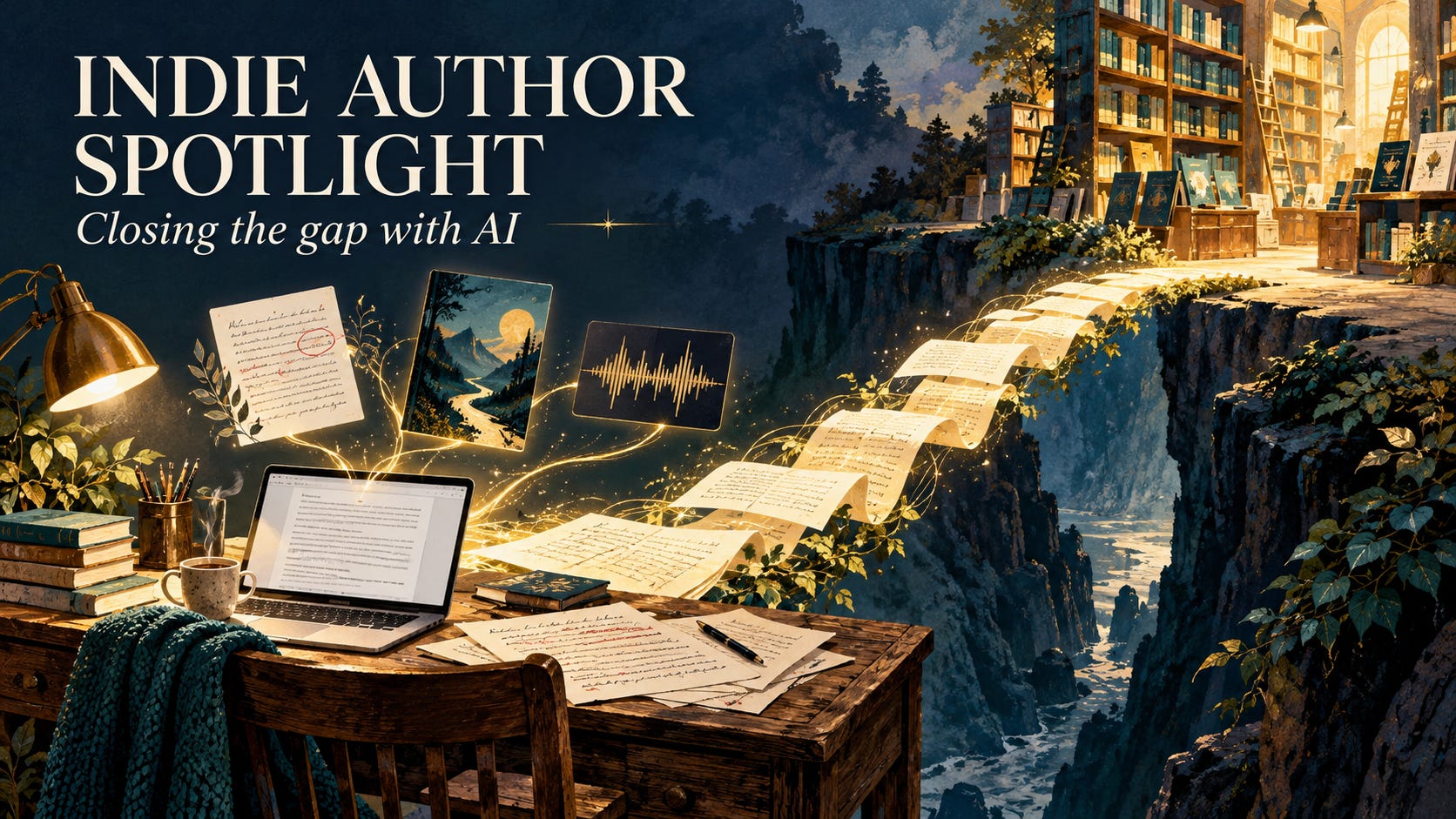
AI in publishing tends to get discussed as a threat, to quality, to jobs, to the slush pile. Less discussed is what it’s actually doing for the author at the opposite end of the budget spectrum from a traditionally published bestseller. Here’s a look at the real numbers behind that gap, and where AI tools are showing up to narrow it.
The Gap, in Dollars
Traditional publishing advances vary enormously by author profile. Debut authors typically see $5,000-$15,000. Established authors land $50,000-$100,000 or more. Highly anticipated titles can reach six or seven figures. That advance usually comes with a baseline marketing push from the publisher, and bigger names are the ones who can also afford to pay for more on top of it: independent publicists run $1,000-$10,000 or more, and launch events add another $500-$2,000-plus.
An indie author with no advance and no publisher backing covers all of that themselves, out of pocket, before a single copy sells. A full developmental edit on an 80,000-word novel runs around $2,400. Line editing adds roughly $3,200. Copyediting is about $1,600, and proofreading another $1,600 on top of that, if all four passes are hired out separately. A professional cover, whether pre-made or custom-illustrated, costs anywhere from $150 to $700 or more. Formatting adds $0-$200 depending on the route. Marketing, from paid ads to BookBub promotions to an author website, can run $0 to $10,000 depending on how far an author pushes it.
Add it up, and a no-name author doing everything the traditionally-recommended way, before touching marketing, is looking at several thousand dollars minimum, with no advance to offset it and no guarantee of recouping any of it.
Where AI Tools Are Showing Up
This is the gap AI tools have been built directly into. A McIlroy study on AI startups in book publishing found that roughly 70% of them target authors specifically, not publishers, a signal that self-publishing is where this technology sees its biggest opening.
A few specific ways that shows up:
Editing support. ChatGPT and Sudowrite are rated among the strongest tools for writing and editing feedback, at a fraction of professional per-word rates, roughly $20/month for ChatGPT’s paid tier, $19-25/month for Sudowrite. Separately, manuscript-analysis tools like Marlowe give authors pacing and prose feedback (overused words, structural issues) without generating text, positioned as a complement to, not a replacement for, a human editor, and as a far cheaper first pass for authors who can’t yet afford one.
Marketing and copy. ChatGPT is named a top tool for marketing copy, SEO metadata, headlines, and keyword research, the kind of work that would otherwise mean hiring a copywriter or a marketing consultant.
Image and cover support. Several tools can generate cover concepts or image prompts, giving authors a lower-cost way to prototype cover ideas before, or instead of, hiring a designer.
Audiobook narration. This is one of the starkest gaps in the lineup. Professional human narration is typically priced per finished hour, generally $100-$250, and a standard 56,000-word novel runs about six finished hours. That puts a human-narrated audiobook at roughly $600-$1,500 before any studio or mastering costs, with full production sometimes reaching $7,000. AI narration tools price by subscription instead: ElevenLabs’ plans run from about $22 to $330 a month, working out to roughly $10-$13 per audio hour depending on the tier. Inkitt has built its own AI-narrated audiobook tool directly into its platform, letting any author turn a published story into an audiobook, chapter by chapter, by choosing a voice for the narrator and each character, paid for through a credit system rather than a per-project rate. None of this is a quality verdict; industry voices still note that AI narration doesn’t yet match the emotional range of a trained human performer for fiction. But it does mean an audiobook edition is financially possible for authors for whom it simply wasn’t before.
Discovery and reach. Platforms including Wattpad and Inkitt already use AI-driven recommendation systems, which some in the industry hope will put indie titles in front of readers on more equal footing with traditionally published books, rather than relying purely on marketing spend to get noticed.
The Caveat Worth Naming
None of the sourcing on this suggests AI is a straightforward replacement for professional editing, design, or narration, and the people building these tools say so themselves. The throughline across commentary is that AI works best as a complement to human judgment, not a substitute for it, lowering the floor an author has to clear rather than raising the ceiling on quality by itself. Traditional publishing’s own margins and sales have been described as declining or stagnant, while self-publishing income has been growing, helped along by exactly these lower-cost production options.
What that means in practice probably looks different for every author. Some will use AI tools to get a manuscript polish-ready before ever paying a human editor. Others will use them to handle marketing copy so a smaller budget can go toward a professional cover instead. The point isn’t that AI closes the entire gap between a six-figure advance and an author working with a few hundred dollars. It’s that the gap is smaller than it used to be, and that’s worth sitting with on its own.
Sources:
- Miblart, “How Much Does It Cost to Self-Publish a Book in 2026”: https://miblart.com/blog/how-much-does-it-cost-to-self-publish-book/
- Ghostwriting Solution, “How Much Does It Cost to Publish a Book Traditionally?”: https://ghostwritingsolution.com/blog/how-much-does-it-cost-to-publish-a-book-traditionally/
- ALLi Self-Publishing Advice, “The AI Revolution: What It Means for Indie Authors”: https://selfpublishingadvice.org/ai-revolution/
- ScribeCount, “AI Platforms Compared for Indie Authors”: https://scribecount.com/author-resource/artificial-intelligence/indie-author-ai-tool-comparison
- Authors Republic, “Your Audiobook Production Budget”: https://authorsrepublic.com/learn/blog/64/your-audiobook-production-budget
- ElevenReader, “Pricing for AI Audiobooks”: https://elevenreader.io/blog/pricing-for-ai-audiobooks
- Inkitt Help Center, “Inkitt Audiobooks”: https://inkitt.zendesk.com/hc/en-us/articles/37697793410962-Inkitt-Audiobooks