

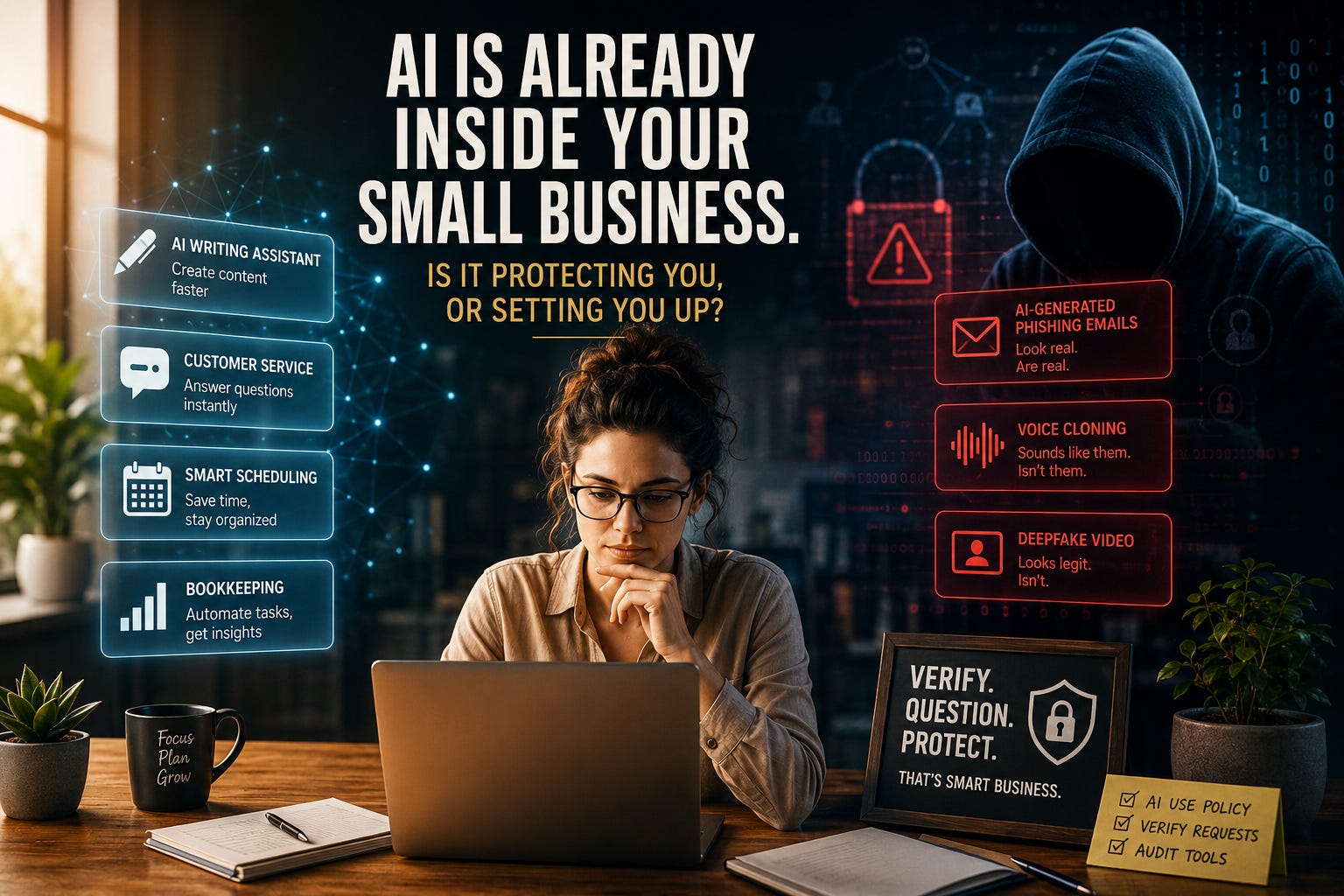
Here’s a number worth sitting with: 72% of small businesses now use at least one AI-powered tool. That’s not a future-of-work statistic anymore — that’s most of your customers, your competitors, and probably your own team.
But there’s a second number that should worry you more. The same AI tools quietly saving small business owners hours every week are being weaponized against those owners right now in their inboxes. AI-crafted scams have gotten good enough that they’re functionally indistinguishable from legitimate business emails. Not “look closely, and you’ll spot it” indistinguishable. Actually indistinguishable.
This is the tension every small business owner is living in this year, whether they’ve named it or not: the tools that make you faster are built on the same technology making fraud faster too.
The opportunity side is real
Let’s not undersell this. The SBA’s July Tech Talk session — “Friend or Fraud: How to Put AI to Work Without Getting Burned” — makes a point worth repeating: the free and low-cost AI tools helping small business owners with writing, customer service, scheduling, and bookkeeping aren’t hype. They’re saving real hours. If you’re a solo operator or a five-person team, that’s not a nice-to-have. That’s the difference between a 60-hour week and a sustainable one.
The mistake isn’t adopting AI. The mistake is adopting it blind — not knowing what happens to the data you type into a free tool, not knowing which of your vendors or platforms are storing your customer information, and not having a plan for the moment someone tries to exploit that gap.
The risk side is just as real
Here’s where it gets sharper. Voice cloning and deepfake video are now good enough to trick employees into authorizing wire transfers — not in some distant enterprise-only scenario, but against businesses exactly your size. If you have even one employee who handles vendor payments or customer financial information, this isn’t abstract risk. It’s operational risk this quarter.
The good news: the fix isn’t complicated. It’s a verification protocol — a simple, non-negotiable rule that no payment or sensitive request gets actioned based on a call or video alone, full stop, every time, no exceptions for “but it sounded just like him.” That one habit stops the vast majority of AI-powered payment fraud cold.
What to actually do this month
Write a one-page AI use policy. Not a 40-page document — a single page covering what tools your team can use, what data never goes into them, and who to ask when unsure. This is doable in an afternoon.
Set a verification rule for money and access. Any request to move funds, change vendor payment details, or share credentials gets confirmed through a second channel — a callback to a known number, not the one in the message.
Audit what you’re already using. ChatGPT, Canva, scheduling tools — know what data goes in and where it lives.
The businesses that win this year won’t be the ones that avoided AI, nor will they be the ones that adopted it carelessly. They’ll be the ones that did both things at once: used it, and protected themselves while doing it.
Sources: SBA Tech Talk — “Friend or Fraud: How to Put AI to Work Without Getting Burned” (sba.gov/event/81921)
Klynn is an AI business educator and commentator covering artificial intelligence trends, enterprise AI adoption, and the business implications of generative AI. Published daily on Medium and Substack, Klynn helps professionals and entrepreneurs understand how AI is transforming industries worldwide. Follow Klynn for daily AI business insights.